Sister Silence
November 28, 2025
“When I started my graduate studies 5 years ago, I made a decision to invite my stutter into the room—the way people have come to leave a seat at the table for silence.”
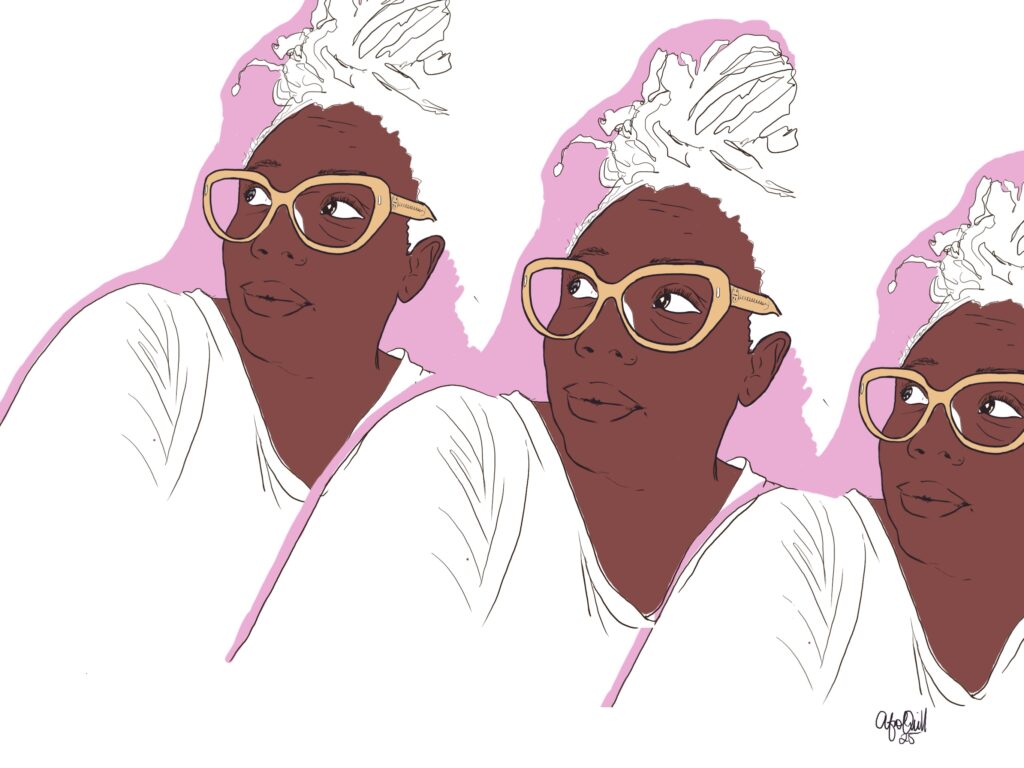
As a person who stutters I have made silence my trusted companion, protector, and weapon. A companion because it was always available to me to remove myself when the flurry of thoughts that ran faster than my cords could handle.
As a graduate student that is looking cautiously at the end of a journey, I have found that silence is a form of winterizing the voice. The winterizing of my voice began when I arrived in Canada in 1980. That is also the first time I noticed I stuttered. Because I was new to a country, a community, a church, and a school I was required to constantly introduce myself. In the village I was born in, Mabouché, I came from a place where the people I lived amongst, went to school with, and worshiped with were all known to each other. The act of introducing the self was replaced with affirming the self through others by their morning greetings and evening salutations. “Good morning” was a way of saying “I see you”. “Good night” felt more like a hope of a greeting to come the next day—”I have seen you through the day—and I will meet you again in the morning”.
So, my arrival in a place where my coming and going meant little to those that I faced each morning and turned my back to at night was met with a silence I eventually saw as a retreat. When the request came to introduce myself by name I further retreated into the silence and found comfort as well as shame. This removal of my voice solidified my identity as a quiet child. Something that never suited me. My voice was very boisterous to me. I was always saying something. However, I soon came to learn that the quiet child identity that was assigned to me was rewarded heavily in spaces like church and school.
Eventually the assignment as a quiet child created a path where it became a form of refusal. A choice to opt out. To decline participation. During those times my anger warmed me. I heard recently that recalling what made us angry is a way to strengthen or reinforce something negative. However, my anger was as a stuttering child in a new country was a way to fight back with the only power I had—the use of my voice. As a former elementary school teacher, I hold the painful and regretful memory of trying to urge a student to speak despite their discomfort. I remember waiting for their words to spill from their tightly clasped lips. I was so disconnected to my own experience with selective speaking that I could not recognize it in someone else who so desperately needed my understanding.
School was always a place where my relationship with my voice was fraught. In the few moments I spoke up in school it was seen as a confrontation by my teachers. Gradually, I found other ways of being heard. It was through the things I could conjure with my hands; an image, the way I wrapped gifts, writing in my journal, calligraphy, and so on. If you have ever received earrings, a painting or drawing, handmade paper, a handmade purse, even a chain for your glasses—you have heard my voice. While finding solace in the winterizing of my voice I also found other ways to signal I was “here”.
Yet, I continued to struggle to accurately express myself verbally with people who did not know me intimately. Because I could not always use the words I wanted I had to select the words that my tongue, cords, and nerves were okay with. This added to the experience with being misunderstood. When I started my graduate studies 5 years ago, I made a decision to invite my stutter into the room—the way people have come to leave a seat at the table for silence. Instead of carrying the shame of my stuttering I wore it like a belt around my waist—echoing a Caribbean saying that many women have heard in our communities, “bind your waist”. In the Caribbean this saying means to brace yourself. I have transformed this saying to mean embolden yourself. Not merely be strong but harness your courage by gathering all the parts of yourself close. Cynthia Dillard’s words also echo an invitation to embolden ourselves through our voice: “Speak. Speak. And speak some more. Speak until the words feel comfortable in your mouth. Speak them in ways that have love at the center, especially love of yourself. And speak them because we have the responsibility, once we have learned or healed ourselves, to go and teach, to heal someone else.”
I now stutter less–maybe speak way too much. Regardless, I am still aware of silence and the ways it continues to show up as a protector, companion, and weapon. I haven’t disregarded it’s uses—instead (inspired by Audre Lorde’s Uses of the Erotic) I see it for what it has always been, “a resource within each of us that lies in a deeply female and spiritual plane, firmly rooted in the power of our unexpressed or unrecognized feeling”. What I chose to do with this silence at the age of 7 and now at the age of 52 is to continue to gather all the uses of silence together and weave them into a belt made to hold the parts of myself that are deep, heavy, and wide for the benefit of myself and my community.
Note: I have left the recording with the stutters and “other guests” as a way to reinforce their invitation.